💎 Zod 4 is now stable!  Read the announcement.
Zod logo

編解碼器 (Codecs)

新功能 — 在 [email protected] 中引入

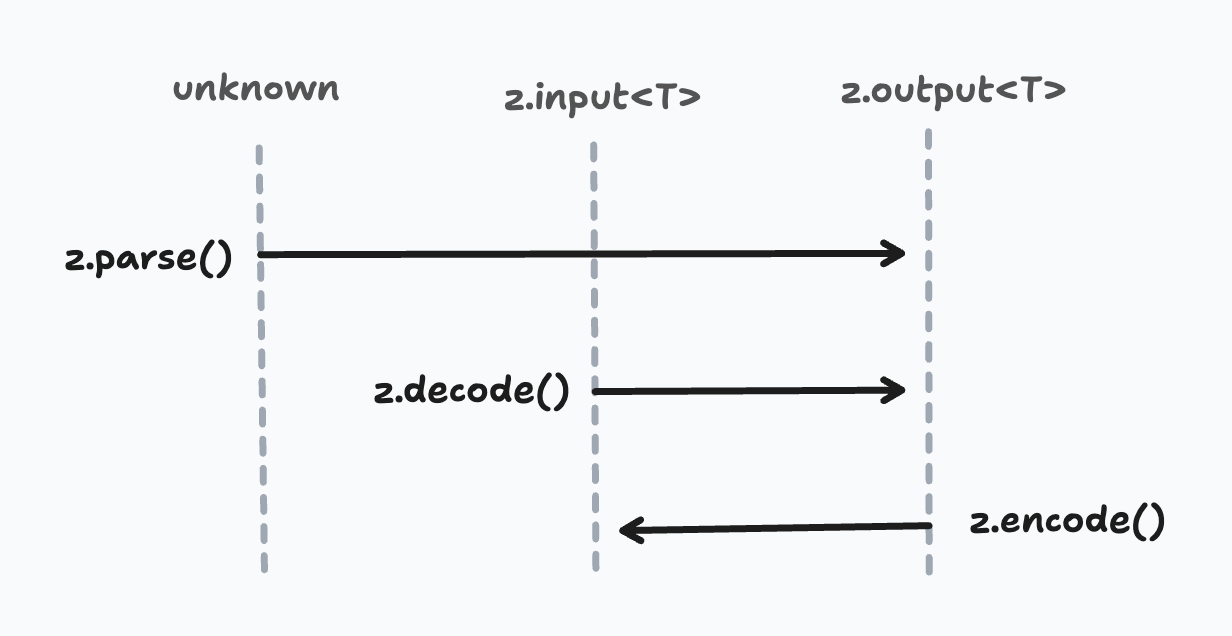
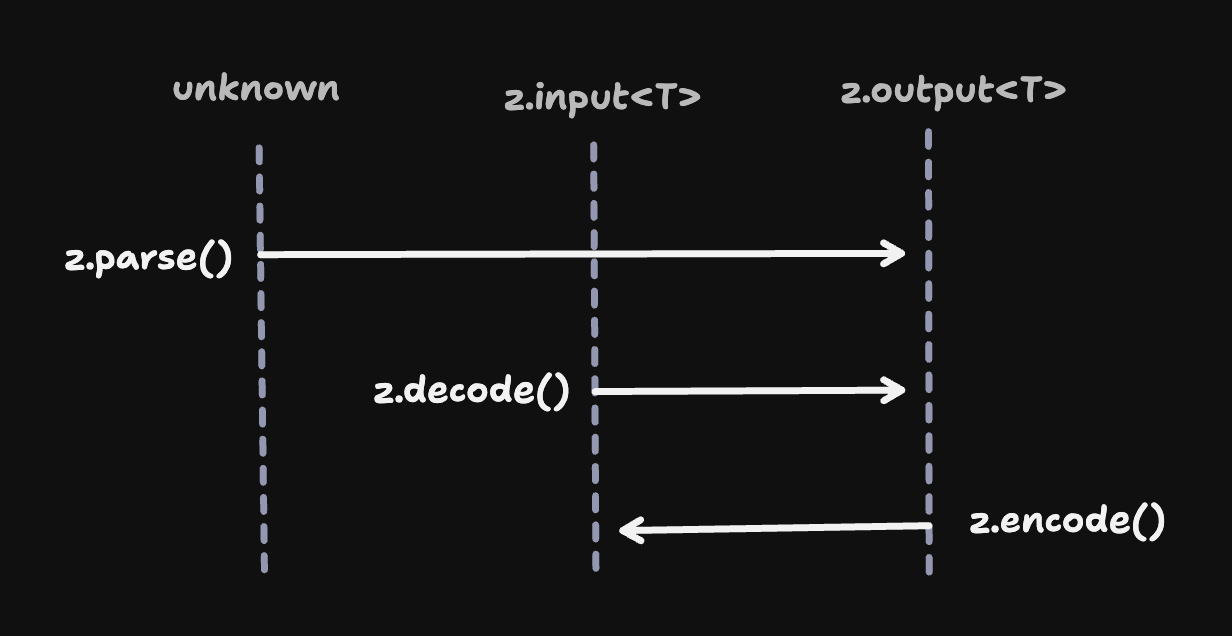
所有 Zod 架構都可以按前向和後向兩個方向處理輸入:

  • 前向 (Forward): InputOutput
    • .parse()
    • .decode()
  • 後向 (Backward): OutputInput
    • .encode()

在大多數情況下,這只是名稱上的區別而沒有實際差異。輸入和輸出類型是相同的,因此「前向」和「後向」沒有區別。

const schema = z.string();
 
type Input = z.input<typeof schema>;    // string
type Output = z.output<typeof schema>;  // string
 
schema.parse("asdf");   // => "asdf"
schema.decode("asdf");  // => "asdf"
schema.encode("asdf");  // => "asdf"

然而,某些架構類型會導致輸入和輸出類型發生分歧,尤其是 z.codec()。編解碼器是一種特殊類型的架構,它定義了另外兩個架構之間的 雙向轉換

const stringToDate = z.codec(
  z.iso.datetime(),  // input schema: ISO date string
  z.date(),          // output schema: Date object
  {
    decode: (isoString) => new Date(isoString), // ISO string → Date
    encode: (date) => date.toISOString(),       // Date → ISO string
  }
);

在這些情況下,z.decode()z.encode() 的行為截然不同。

stringToDate.decode("2024-01-15T10:30:00.000Z")
// => Date
 
stringToDate.encode(new Date("2024-01-15T10:30:00.000Z"))
// => string

注意 — 這裡的方向或術語沒有什麼特別的。你可以用 B -> A 編解碼器進行 解碼,而不是用 A -> B 編解碼器進行 編碼。「解碼」和「編碼」這些術語的使用只是一種約定。

這在解析網絡邊界處的數據時特別有用。您可以在客戶端和服務器之間共享單個 Zod 架構,然後使用這單個架構在網絡友好格式(例如 JSON)和更豐富的 JavaScript 表示之間進行轉換。

Codecs encoding and decoding data across a network boundary

可組合性 (Composability)

注意 — 您可以將 z.encode()z.decode() 用於任何架構。它不必是 ZodCodec。

編解碼器像其他任何架構一樣。您可以將它們嵌套在對象、數組、管道等內部。對於在哪裡可以使用它們沒有規則!

const payloadSchema = z.object({ 
  startDate: stringToDate 
});
 
payloadSchema.decode({
  startDate: "2024-01-15T10:30:00.000Z"
}); // => { startDate: Date }

類型安全輸入 (Type-safe inputs)

雖然 .parse().decode()運行時 表現相同,但它們具有不同的類型簽名。.parse() 方法接受 unknown 作為輸入,並返回與架構推斷的 輸出類型 匹配的值。相比之下,z.decode()z.encode() 函數具有 強類型輸入

stringToDate.parse(12345); 
// no complaints from TypeScript (fails at runtime)
 
stringToDate.decode(12345); 
// ❌ TypeScript error: Argument of type 'number' is not assignable to parameter of type 'string'.
 
stringToDate.encode(12345); 
// ❌ TypeScript error: Argument of type 'number' is not assignable to parameter of type 'Date'.

為什麼會有差異?編碼和解碼意味著 轉換。在許多情況下,這些方法的輸入在應用程序代碼中已經是強類型的,因此 z.decode/z.encode 接受強類型輸入以在編譯時顯示錯誤。 這是一張演示 parse()decode()encode() 的類型簽名之間差異的圖表。

Codec directionality diagram showing bidirectional transformation between input and output schemas

異步和安全變體 (Async and safe variants)

.transform().refine() 一樣,編解碼器支持異步轉換。

const asyncCodec = z.codec(z.string(), z.number(), {
  decode: async (str) => Number(str),
  encode: async (num) => num.toString(),
});

與常規 parse() 一樣,decode()encode() 也有「安全」和「異步」變體。

stringToDate.decode("2024-01-15T10:30:00.000Z"); 
// => Date
 
stringToDate.decodeAsync("2024-01-15T10:30:00.000Z"); 
// => Promise<Date>
 
stringToDate.safeDecode("2024-01-15T10:30:00.000Z"); 
// => { success: true, data: Date } | { success: false, error: ZodError }
 
stringToDate.safeDecodeAsync("2024-01-15T10:30:00.000Z"); 
// => Promise<{ success: true, data: Date } | { success: false, error: ZodError }>

編碼的工作原理 (How encoding works)

某些 Zod 架構如何「反轉」其解析行為存在一些細微差別。

編解碼器 (Codecs)

這一點不言自明。編解碼器封裝了兩種類型之間的雙向轉換。z.decode() 觸發 decode 轉換以將輸入轉換為解析值,而 z.encode() 觸發 encode 轉換以將其序列化回來。

const stringToDate = z.codec(
  z.iso.datetime(),  // input schema: ISO date string
  z.date(),          // output schema: Date object
  {
    decode: (isoString) => new Date(isoString), // ISO string → Date
    encode: (date) => date.toISOString(),       // Date → ISO string
  }
);
 
stringToDate.decode("2024-01-15T10:30:00.000Z"); 
// => Date
 
stringToDate.encode(new Date("2024-01-15")); 
// => string

管道 (Pipes)

有趣的事實 — 編解碼器實際上在內部實現為管道的 子類,並增加了「間隙」轉換邏輯。

在常規解碼期間,ZodPipe<A, B> 架構將首先用 A 解析數據,然後將其傳遞給 B。正如您所料,在編碼期間,數據首先用 B 編碼,然後傳遞給 A

細化 (Refinements)

所有檢查(.refine().min().max() 等)仍然在兩個方向上執行。

const schema = stringToDate.refine((date) => date.getFullYear() >= 2000, "Must be this millennium");
 
schema.encode(new Date("2000-01-01"));
// => Date
 
schema.encode(new Date("1999-01-01"));
// => ❌ ZodError: [
//   {
//     "code": "custom",
//     "path": [],
//     "message": "Must be this millennium"
//   }
// ]

為了避免自定義 .refine() 邏輯中出現意外錯誤,Zod 在 z.encode() 期間執行兩次「傳遞」。第一次傳遞確保輸入類型符合預期類型(沒有 invalid_type 錯誤)。如果該傳遞通過,Zod 將執行第二次傳遞,該傳遞執行細化邏輯。

這種方法還支持「變異轉換」,如 z.string().trim()z.string().toLowerCase()

const schema = z.string().trim();
 
schema.decode("  hello  ");
// => "hello"
 
schema.encode("  hello  ");
// => "hello"

默認值和預設值 (Defaults and prefaults)

默認值和預設值僅在「前向」方向應用。

const stringWithDefault = z.string().default("hello");
 
stringWithDefault.decode(undefined); 
// => "hello"
 
stringWithDefault.encode(undefined); 
// => ZodError: Expected string, received undefined

當您將默認值附加到架構時,輸入變為可選的 (| undefined),但輸出不是。因此,undefined 不是 z.encode() 的有效輸入,並且不會應用默認值/預設值。

捕獲 (Catch)

同樣,.catch() 僅在「前向」方向應用。

const stringWithCatch = z.string().catch("hello");
 
stringWithCatch.decode(1234); 
// => "hello"
 
stringWithCatch.encode(1234); 
// => ZodError: Expected string, received number

Stringbool

注意Stringbool 早於 Zod 中編解碼器的引入。它後來在內部重新實現為編解碼器。

z.stringbool() API 將字串值("true""false""yes""no" 等)轉換為 boolean。默認情況下,它將在 z.encode() 期間將 true 轉換為 "true",將 false 轉換為 "false"

const stringbool = z.stringbool();
 
stringbool.decode("true");  // => true
stringbool.decode("false"); // => false
 
stringbool.encode(true);    // => "true"
stringbool.encode(false);   // => "false"

如果您指定一組自定義的 truthy(真值)和 falsy(假值)值,則將使用 數組中的第一個元素

const stringbool = z.stringbool({ truthy: ["yes", "y"], falsy: ["no", "n"] });
 
stringbool.encode(true);    // => "yes"
stringbool.encode(false);   // => "no"

轉換 (Transforms)

⚠️ — .transform() API 實現了 單向 轉換。如果在您的架構中任何地方存在 .transform(),嘗試 z.encode() 操作將拋出 運行時錯誤(而不是 ZodError)。

const schema = z.string().transform(val => val.length);
 
schema.encode(1234); 
// ❌ Error: Encountered unidirectional transform during encode: ZodTransform

有用的編解碼器 (Useful codecs)

以下是一些常用編解碼器的實現。為了可定製性,這些未作為一等 API 包含在 Zod 本身中。相反,您應該將它們複製/粘貼到您的項目中並根據需要進行修改。

注意 — 所有這些編解碼器實現都已通過正確性測試。

stringToNumber

使用 parseFloat() 將數字的字串表示形式轉換為 JavaScript number 類型。

const stringToNumber = z.codec(z.string().regex(z.regexes.number), z.number(), {
  decode: (str) => Number.parseFloat(str),
  encode: (num) => num.toString(),
});
 
stringToNumber.decode("42.5");  // => 42.5
stringToNumber.encode(42.5);    // => "42.5"

stringToInt

使用 parseInt() 將整數的字串表示形式轉換為 JavaScript number 類型。

const stringToInt = z.codec(z.string().regex(z.regexes.integer), z.int(), {
  decode: (str) => Number.parseInt(str, 10),
  encode: (num) => num.toString(),
});
 
stringToInt.decode("42");  // => 42
stringToInt.encode(42);    // => "42"

stringToBigInt

將字串表示形式轉換為 JavaScript bigint 類型。

const stringToBigInt = z.codec(z.string(), z.bigint(), {
  decode: (str) => BigInt(str),
  encode: (bigint) => bigint.toString(),
});
 
stringToBigInt.decode("12345");  // => 12345n
stringToBigInt.encode(12345n);   // => "12345"

numberToBigInt

將 JavaScript number 轉換為 bigint 類型。

const numberToBigInt = z.codec(z.int(), z.bigint(), {
  decode: (num) => BigInt(num),
  encode: (bigint) => Number(bigint),
});
 
numberToBigInt.decode(42);   // => 42n
numberToBigInt.encode(42n);  // => 42

isoDatetimeToDate

將 ISO 日期時間字串轉換為 JavaScript Date 對象。

const isoDatetimeToDate = z.codec(z.iso.datetime(), z.date(), {
  decode: (isoString) => new Date(isoString),
  encode: (date) => date.toISOString(),
});
 
isoDatetimeToDate.decode("2024-01-15T10:30:00.000Z");  // => Date object
isoDatetimeToDate.encode(new Date("2024-01-15"));       // => "2024-01-15T00:00:00.000Z"

epochSecondsToDate

將 Unix 時間戳(自紀元以來的秒數)轉換為 JavaScript Date 對象。

const epochSecondsToDate = z.codec(z.int().min(0), z.date(), {
  decode: (seconds) => new Date(seconds * 1000),
  encode: (date) => Math.floor(date.getTime() / 1000),
});
 
epochSecondsToDate.decode(1705314600);  // => Date object
epochSecondsToDate.encode(new Date());  // => Unix timestamp in seconds

epochMillisToDate

將 Unix 時間戳(自紀元以來的毫秒數)轉換為 JavaScript Date 對象。

const epochMillisToDate = z.codec(z.int().min(0), z.date(), {
  decode: (millis) => new Date(millis),
  encode: (date) => date.getTime(),
});
 
epochMillisToDate.decode(1705314600000);  // => Date object
epochMillisToDate.encode(new Date());     // => Unix timestamp in milliseconds

json(schema)

將 JSON 字串解析為結構化數據並序列化回 JSON。此泛型函數接受一個輸出架構來驗證解析後的 JSON 數據。

const jsonCodec = <T extends z.core.$ZodType>(schema: T) =>
  z.codec(z.string(), schema, {
    decode: (jsonString, ctx) => {
      try {
        return JSON.parse(jsonString);
      } catch (err: any) {
        ctx.issues.push({
          code: "invalid_format",
          format: "json",
          input: jsonString,
          message: err.message,
        });
        return z.NEVER;
      }
    },
    encode: (value) => JSON.stringify(value),
  });

特定架構的使用示例:

const jsonToObject = jsonCodec(z.object({ name: z.string(), age: z.number() }));
 
jsonToObject.decode('{"name":"Alice","age":30}');  
// => { name: "Alice", age: 30 }
 
jsonToObject.encode({ name: "Bob", age: 25 });     
// => '{"name":"Bob","age":25}'
 
jsonToObject.decode('~~invalid~~'); 
// ZodError: [
//   {
//     "code": "invalid_format",
//     "format": "json",
//     "path": [],
//     "message": "Unexpected token '~', \"~~invalid~~\" is not valid JSON"
//   }
// ]

utf8ToBytes

將 UTF-8 字串轉換為 Uint8Array 字節數組。

const utf8ToBytes = z.codec(z.string(), z.instanceof(Uint8Array), {
  decode: (str) => new TextEncoder().encode(str),
  encode: (bytes) => new TextDecoder().decode(bytes),
});
 
utf8ToBytes.decode("Hello, 世界!");  // => Uint8Array
utf8ToBytes.encode(bytes);          // => "Hello, 世界!"

bytesToUtf8

Uint8Array 字節數組轉換為 UTF-8 字串。

const bytesToUtf8 = z.codec(z.instanceof(Uint8Array), z.string(), {
  decode: (bytes) => new TextDecoder().decode(bytes),
  encode: (str) => new TextEncoder().encode(str),
});
 
bytesToUtf8.decode(bytes);          // => "Hello, 世界!"
bytesToUtf8.encode("Hello, 世界!");  // => Uint8Array

base64ToBytes

將 base64 字串轉換為 Uint8Array 字節數組,反之亦然。

const base64ToBytes = z.codec(z.base64(), z.instanceof(Uint8Array), {
  decode: (base64String) => z.util.base64ToUint8Array(base64String),
  encode: (bytes) => z.util.uint8ArrayToBase64(bytes),
});
 
base64ToBytes.decode("SGVsbG8=");  // => Uint8Array([72, 101, 108, 108, 111])
base64ToBytes.encode(bytes);       // => "SGVsbG8="

base64urlToBytes

將 base64url 字串(URL 安全的 base64)轉換為 Uint8Array 字節數組。

const base64urlToBytes = z.codec(z.base64url(), z.instanceof(Uint8Array), {
  decode: (base64urlString) => z.util.base64urlToUint8Array(base64urlString),
  encode: (bytes) => z.util.uint8ArrayToBase64url(bytes),
});
 
base64urlToBytes.decode("SGVsbG8");  // => Uint8Array([72, 101, 108, 108, 111])
base64urlToBytes.encode(bytes);      // => "SGVsbG8"

hexToBytes

將十六進制字串轉換為 Uint8Array 字節數組,反之亦然。

const hexToBytes = z.codec(z.hex(), z.instanceof(Uint8Array), {
  decode: (hexString) => z.util.hexToUint8Array(hexString),
  encode: (bytes) => z.util.uint8ArrayToHex(bytes),
});
 
hexToBytes.decode("48656c6c6f");     // => Uint8Array([72, 101, 108, 108, 111])
hexToBytes.encode(bytes);            // => "48656c6c6f"

stringToURL

將 URL 字串轉換為 JavaScript URL 對象。

const stringToURL = z.codec(z.url(), z.instanceof(URL), {
  decode: (urlString) => new URL(urlString),
  encode: (url) => url.href,
});
 
stringToURL.decode("https://example.com/path");  // => URL object
stringToURL.encode(new URL("https://example.com"));  // => "https://example.com/"

stringToHttpURL

將 HTTP/HTTPS URL 字串轉換為 JavaScript URL 對象。

const stringToHttpURL = z.codec(z.httpUrl(), z.instanceof(URL), {
  decode: (urlString) => new URL(urlString),
  encode: (url) => url.href,
});
 
stringToHttpURL.decode("https://api.example.com/v1");  // => URL object
stringToHttpURL.encode(url);                           // => "https://api.example.com/v1"

uriComponent

使用 encodeURIComponent()decodeURIComponent() 對 URI 組件進行編碼和解碼。

const uriComponent = z.codec(z.string(), z.string(), {
  decode: (encodedString) => decodeURIComponent(encodedString),
  encode: (decodedString) => encodeURIComponent(decodedString),
});
 
uriComponent.decode("Hello%20World%21");  // => "Hello World!"
uriComponent.encode("Hello World!");      // => "Hello%20World!"